

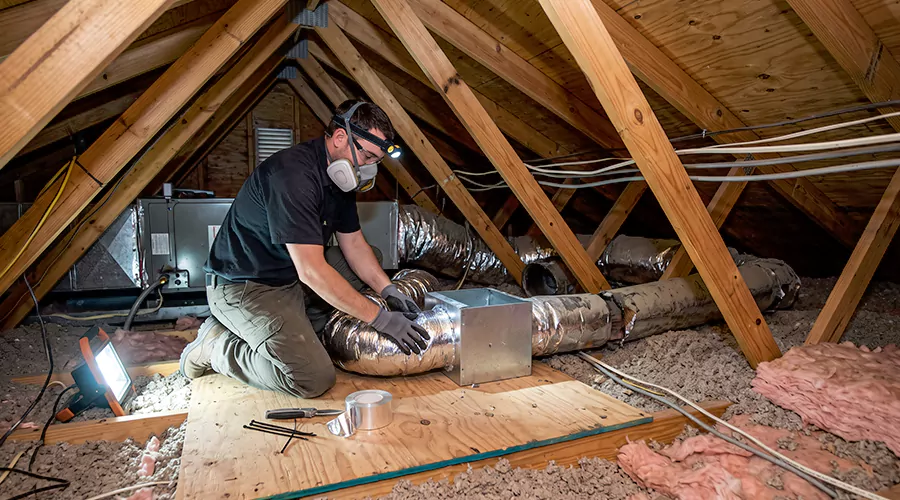
Attic air duct replacement typically costs $2,200 to $5,600 for many residential projects in the United States, based on published replacement estimates. Replacing only one damaged duct run may cost approximately $270 to $500 in a straightforward installation, while extensive attic replacement can exceed $6,000. The final price depends on duct length, material, attic accessibility, insulation requirements, and whether the system needs redesign.
Attic ductwork carries heated and cooled air between HVAC equipment and the rooms below. In many homes, flexible ducts connect a main supply trunk or junction box to ceiling registers. These passages must remain airtight and properly insulated because a vented attic can become extremely hot during summer and cold during winter.
Over time, ductwork may develop problems that justify air duct replacement. Flexible sections can become crushed by stored items or damaged by poor support, while metal ducts may develop extensive corrosion when exposed to persistent moisture. An older installation may also contain excessive bends or unsuitable duct sizes that restrict airflow.
Replacing attic ducts can improve performance when the existing passages are damaged or incorrectly designed. However, the entire system does not always need replacement. Understanding the costs of individual branches and larger projects helps homeowners choose a repair scope that addresses the actual problem.
What Is the Average Attic Duct Replacement Cost in 2026?
HomeGuide's published U.S. duct replacement estimates place attic projects between $2,200 and $5,600. These costs include materials and labor for residential replacement projects of varying sizes. Smaller jobs may cost less, while larger systems or unusually difficult attic conditions can exceed the range.
A national price estimate cannot describe every attic installation. Some homes have several short flexible branches that are relatively accessible. Others contain extensive main ducts and return passages routed across large, difficult-to-reach attic areas.
| Attic Duct Replacement Scope | Estimated U.S. Cost |
|---|---|
| One straightforward duct run | $270–$500 |
| Limited replacement involving several runs | Site-specific, based on footage and access |
| Typical residential attic duct replacement | $2,200–$5,600 |
| Extensive or complicated attic system | $6,000 or more |
| Replacement priced by length | Commonly $25–$55 per linear foot |
| Additional attic insulation project | Approximately $800–$1,500 in some published estimates |
The figures describe different project scopes and should not automatically be added together. A whole-system quote may already include insulated duct materials and removal of the old passages. Adding attic floor insulation is a different service that may or may not be needed.
The contractor should inspect the existing system before recommending a price. A damaged flexible branch and a structurally sound metal trunk require different responses. Replacing the entire attic network is not automatically necessary when only one section has failed.
How Much Does Attic Duct Replacement Cost per Linear Foot?
Published U.S. estimates commonly place ductwork replacement between $25 and $55 per linear foot, including removal and installation. Some other cost guides report lower per-foot figures based on different project samples. For budgeting, homeowners should confirm exactly which tasks the contractor includes in the unit rate.
A linear foot is the length of ductwork measured along its installed route. It does not include information about the duct diameter or number of fittings. These details affect material quantities and installation time.
The following table uses the $25 to $55 per-foot pricing range.
| Amount of Attic Ductwork | Illustrative Replacement Cost |
|---|---|
| 20 linear feet | $500–$1,100 |
| 40 linear feet | $1,000–$2,200 |
| 60 linear feet | $1,500–$3,300 |
| 80 linear feet | $2,000–$4,400 |
| 100 linear feet | $2,500–$5,500 |
| 120 linear feet | $3,000–$6,600 |
These amounts are calculations, not guaranteed prices for attic projects. They do not account individually for attic access restrictions or design changes. A contractor may also offer a fixed price that differs from the calculated total.
The most useful question is whether the price covers a complete installed duct run. That should include suitable fittings, mechanical connections, sealing, insulation, and support. A low material-only rate is not equivalent to the cost of a finished installation.
How Much Does It Cost to Replace One Duct Run in an Attic?
Replacing an individual duct run commonly costs $270 to $500 for straightforward work in published residential estimates. The project may involve removing one damaged flexible branch and connecting a replacement between an existing supply fitting and ceiling register. The actual price changes with length, size, and access.
A short run near the attic entrance may be relatively easy to replace. A branch extending through low-clearance framing can take longer because the installer must work carefully around surrounding materials. The price may also rise when the register boot or connection collar is damaged.
Replacing only the affected branch is often the sensible option when other ducts remain sound. For example, one flexible duct crushed by stored boxes may not justify replacing every branch. The contractor should confirm that the new duct matches the system's airflow requirements.
However, replacing a duct with the same dimensions is not always correct. If the original branch was undersized, an appropriate design review may recommend a different diameter or route. The estimate should explain whether the work is an equivalent replacement or a design correction.
How Much Does Attic Duct Replacement Cost by Home Size?
Home size influences the amount of ductwork, but there is no standard attic replacement price for every square-foot category. A house's floor area does not reveal how many ducts are installed in its attic or how much of the system needs replacement. The number of rooms and HVAC zones matters as well.
The following table presents published general residential duct replacement estimates by home size. They are useful for planning but are not specific attic-only averages.
| Home Size | General Residential Duct Replacement Estimate |
|---|---|
| 1,000–1,500 square feet | $1,400–$3,400 |
| 1,500–2,000 square feet | $2,100–$4,500 |
| 2,000–2,500 square feet | $2,800–$5,600 |
| 2,500–3,000 square feet | $3,500–$6,700 |
| 3,000–3,500 square feet | $4,200–$7,800 |
| 3,500–4,000 square feet | $4,900–$9,000 |
An attic-specific quote can be higher or lower than these estimates because the system may contain more or fewer accessible runs. Some multistory homes also have ducts in walls or between floors rather than entirely in the attic. The project should be priced from the actual replacement scope.
A contractor may need to measure the branch and trunk lengths before preparing a final quote. Existing plans can help, but the physical layout should be checked because renovations may have changed the system.
Why Does Attic Duct Replacement Cost More Than Some Other Locations?
Attic work can be more difficult than replacing exposed ducts in an unfinished basement. The installer may have limited headroom and no continuous walking surface. Heat and insulation conditions can also slow work.
Some ducts are installed near roof framing or beneath blown insulation, making them harder to remove without disturbing surrounding materials. A contractor must protect electrical wiring, framing, and ceiling surfaces while carrying materials through the attic.
Attic accessibility can also influence the type of duct selected. Flexible ducts may be convenient for certain branch routes, but they still require support and suitable connection fittings. A rigid metal section may be needed where the route cannot maintain a gentle flexible bend.
The location should be evaluated before work begins because labor conditions may account for a significant portion of the quote.
What Factors Affect Attic Air Duct Replacement Prices?
Several factors influence the final cost of replacing attic ducts. Some affect material quantities, while others increase labor or require additional building repairs. Understanding these differences helps homeowners identify which charges are justified.
Number of Duct Runs
The number of branches being replaced is one of the largest cost factors. Each run requires material and appropriate connections at its endpoints. A project involving twelve branches requires more installation work than replacing three damaged branches.
However, not every branch has the same length or diameter. A larger duct may contain more material and insulation than a smaller branch. A reliable estimate should identify the individual runs rather than count every branch as identical.
Flexible Versus Metal Ductwork
Flexible ducts are commonly used in residential attics because they can be routed around framing with relatively simple fittings. Their installation cost is influenced by insulation, support straps, and properly secured connections. Incorrect installation can cause sagging or compression that reduces airflow.
Rigid metal ducts may require additional fabrication and fitting labor. They can provide a durable, smooth passage when installed correctly. The best material depends on the duct design and site conditions rather than price alone.
Some projects use a combination of metal trunks and flexible branches. The estimate should identify the materials used in each section.
Attic Access and Working Clearance
An attic with a large access opening and suitable working platforms may be less difficult than one with a narrow hatch and restricted clearance. Installers must avoid unsupported ceiling drywall and other hazards. Limited access can increase the time required to remove and position ducts.
Attic temperatures also affect work planning. Crews may need to limit exposure during hot weather or adjust the schedule. This can influence labor and project duration.
The quote should be based on actual site conditions rather than assume every attic is equally accessible.
Insulation Requirements
Attic ducts outside conditioned space need insulation suited to the installation. Some residential energy-efficiency programs call for R-8 insulation on attic supply ducts, while different ratings may apply to return ducts. Local code requirements and manufacturer instructions determine the actual specification.
Insulated flexible ducts often arrive with an integrated insulation layer and outer jacket. Rigid metal ducts may require separate insulation after joints are installed and sealed. The material and labor should be included in the quote.
A lower-cost duct with insufficient insulation can increase heat gain or loss. It may also contribute to condensation under certain conditions. Insulation performance is part of the finished installation, not merely an optional appearance feature.
Duct Design and Airflow Corrections
An existing system may need redesign because its ducts are undersized or poorly routed. Correcting these problems can require new fittings, different branch sizes, or changes to the return network. This increases the project scope beyond replacing damaged material with an identical part.
ACCA Manual D provides recognized residential duct design principles. A properly developed plan considers the equipment's blower capacity and the airflow needed by each room. The contractor should explain when design calculations are included.
Replacing an incorrectly sized duct with the same dimensions may not solve the comfort problem. Paying for an appropriate design can avoid repeating the original installation defect.
Old Duct Removal and Disposal
Removing existing ductwork takes labor, particularly when branches pass beneath framing or are covered by insulation. The contractor must avoid damaging components intended to remain. Disposal should also be handled according to the material's condition.
Some contractors include removal and cleanup within the installation price. Others identify it as a separate charge. The estimate should explain whether the old material will be removed from the property.
Older duct wrapping and attic insulation may require special precautions when asbestos is suspected. Such materials should not be disturbed until qualified assessment and any required specialized handling have been arranged.
Does Attic Duct Insulation Increase Replacement Cost?
Insulation affects replacement cost because the materials need to reduce heat transfer between conditioned air and the attic. A duct installed without suitable insulation can absorb heat during cooling or lose heat during heating. Proper insulation also helps reduce condensation risks where temperature differences are substantial.
Pre-insulated flexible ducts include insulation as part of the product. For sheet metal, separate insulation or another approved method may be necessary. The contractor should identify the proposed insulation rating and whether it is included in the installed duct price.
Published estimates for separate attic insulation projects sometimes range from $800 to $1,500. However, that figure generally describes broader attic insulation work, not simply the cost of insulating a replacement duct. These should be distinguished in the quote.
Attic floor insulation and duct insulation serve related but different purposes. Replacing one does not automatically mean the other needs replacement. Both should be evaluated according to the home's existing condition.
Is Replacing Attic Ductwork Cheaper Than Repairing It?
Repair is generally less expensive when the duct remains sound and the defect is localized. A leaking metal joint may be mechanically secured and sealed using approved materials. A small damaged area of exterior insulation may also be repairable without replacing the air-carrying passage.
Replacement becomes more appropriate when the material has collapsed or deteriorated extensively. A flexible duct with a permanently crushed liner may remain restrictive after attempts to straighten it. A heavily rusted metal section may no longer support a durable patch.
| Attic Duct Condition | Likely Recommendation |
|---|---|
| Minor leak at a sound metal joint | Secure and seal |
| Loose connection with intact material | Reattach and seal |
| Small exterior insulation tear | Repair protective covering where suitable |
| Severely crushed flexible duct | Replace affected run |
| Extensive inner-liner damage | Replace affected section |
| Heavily corroded metal duct | Replace deteriorated section |
| Wet or moldy fiberglass duct material | Replace affected material |
| Incorrect duct sizing | Redesign and replace as needed |
The contractor should explain why repair is not sufficient before proposing replacement. A whole-house project is difficult to justify when only one accessible branch has failed. Replacing selected sections can reduce cost when the rest of the network remains serviceable.
What Additional Costs Should You Expect?
Attic duct replacement can reveal related work that is not included in a basic installation quote. The homeowner may need repairs to register boots or damaged trunk connections. Additional ceiling or attic insulation work may also be necessary where materials have been disturbed.
Published 2026 cost guides provide example ranges of $200 to $600 for design work and $100 to $300 for certain inspections when billed separately. These are not universal charges. Permit fees and requirements depend on the location of the property.
Common possible additions include:
- Duct design and sizing calculations.
- Permits and required inspections.
- Replacement of damaged junction boxes.
- Repairs to ceiling register boots.
- Additional duct insulation.
- Attic access improvements.
- Old duct disposal and cleanup.
- Air leakage and airflow testing.
- Repair of moisture-damaged attic materials.
- Specialized assessment or removal of hazardous insulation.
Not every project requires these services. A straightforward replacement may already include several of them. The estimate should identify which costs are included and which would need separate approval.
How Long Does Attic Air Duct Replacement Take?
Many routine residential attic duct replacement projects can be completed within one to two working days. Replacing only one or two branches may take less time. Extensive systems with custom metal work or restricted access may need several days.
A project schedule should account for more than physical installation. Removing old ducts and preparing fittings take time, as do sealing and restoring insulation. Final testing is also necessary to confirm that the ducts are functioning as intended.
Attic heat can affect when crews can work safely. A contractor may schedule work during cooler hours or split installation across multiple periods. Safety-related changes to the schedule should be considered when arranging equipment downtime.
Homeowners should ask how long the HVAC system will be unavailable. Planning the installation around extreme weather can make the project easier to manage.
Can Replacing Attic Ducts Reduce Energy Costs?
Replacing damaged attic ducts may reduce energy waste when the original system contains substantial leaks or insufficient insulation. ENERGY STAR reports that typical homes can lose approximately 20% to 30% of air moving through ducts because of leakage and poor connections. Ducts located in unconditioned attics can make such losses particularly costly.
However, this figure is not a promise of an equivalent reduction in energy bills. The actual result depends on how much air was leaking and the performance of the replacement system. A house with mostly sound ducts may see a smaller difference.
Proper installation is necessary to realize the benefit. New ducts can still leak when connections are not mechanically secured and sealed. Insulation and airflow design also determine how effectively conditioned air reaches the rooms.
The contractor should verify the system after installation rather than assume that replacement alone produces the intended improvement.
What Should Be Included in an Attic Duct Replacement Quote?
A detailed quote should identify the amount of ductwork to be installed and the materials used. The contractor should explain whether the project includes both supply and return ducts or only selected branches. A general price without a defined scope is difficult to compare fairly.
Before approving the work, confirm:
- How many duct runs will be replaced?
- What is the approximate total linear footage?
- Which existing ducts will remain?
- What material and insulation rating will be used?
- Are new fittings and junction boxes included?
- Will ducts be mechanically supported and sealed?
- Is removal of old material included?
- Are permits and required inspections included?
- Will duct leakage testing be performed?
- Will room airflow be checked?
- Are related ceiling or insulation repairs included?
- What warranty applies to the installation?
The quote should also explain whether the contractor is following the existing layout or redesigning the system. These are different amounts of work and can produce different results. A lower price may not be a better value if it repeats known sizing problems.
Should You Replace All Attic Ducts at Once?
Replacing all attic ducts can make sense when most of the system is damaged or incorrectly designed. A complete project allows the contractor to coordinate branch sizing and routing. It may also reduce repeated installation labor compared with replacing many failing runs separately over time.
However, broad replacement is not automatically necessary when the damage is limited. A sound metal trunk and several intact flexible branches may remain suitable. Replacing only the failed sections can reduce material and labor costs.
A qualified inspection should determine whether the problems are isolated or widespread. The contractor should provide photographs or other evidence supporting the recommendation. Homeowners can then compare the expected cost and benefit of limited versus complete replacement.
When a complete redesign is proposed, the new layout should address room airflow requirements. Replacing every duct without correcting poor sizing can leave persistent comfort problems.
How Can You Save Money on Attic Duct Replacement?
The best way to avoid unnecessary spending is to define the scope accurately. Start with an inspection of the existing ducts and ask which sections can be repaired. A sound duct does not need replacement simply because a neighboring branch has deteriorated.
Request at least two itemized estimates using similar material and insulation specifications. Compare the total footage and number of branches, not only the final price. Confirm that each contractor includes sealing, support, and appropriate testing.
If the home needs other attic work, coordinate scheduling carefully. For example, roof leak repairs should be completed before installing new duct insulation in the affected area. This prevents new materials from being exposed to a known moisture problem.
Do not reduce costs by omitting insulation or proper mechanical support. Poor installation can create operating expenses and repair work that outweigh the initial savings.
What Mistakes Can Make Attic Duct Replacement More Expensive?
Several installation problems can cause a new duct system to perform badly or require early repairs. The most costly mistakes involve incorrect sizing and poor support. A replacement system should not simply repeat the physical arrangement that caused the original failure.
Avoid these problems:
- Replacing sound ducts without documenting damage.
- Installing ducts with an incorrect diameter.
- Leaving excessive flexible duct length in the attic.
- Creating tight bends around framing.
- Using narrow straps that compress insulation.
- Leaving long sections unsupported.
- Failing to secure the inner duct liner to fittings.
- Sealing joints with ordinary cloth-backed tape.
- Leaving gaps in duct insulation or vapor barriers.
- Ignoring return duct leakage.
- Installing new ducts before repairing roof leaks.
- Disturbing suspected asbestos-containing material.
- Omitting required permits or inspections.
- Skipping airflow and leakage testing.
These issues can contribute to reduced airflow and unwanted heat gain or loss. Correcting them after the installation is complete may require additional attic access and labor. Reviewing the design and work quality during installation helps prevent unnecessary expense.
When Should You Hire an HVAC Contractor?
An HVAC contractor should evaluate attic ductwork when several branches are damaged or the system has persistent airflow problems. The contractor can identify the correct duct sizes and determine whether replacement is necessary. Substantial attic work also benefits from experienced installation and safety procedures.
Ask whether the company performs duct design and post-installation testing. A contractor should be able to explain how connections will be fastened, sealed, and insulated. The estimate should also address attic access and any suspected hazardous materials.
Professional help is particularly important when the system needs changes to main ducts or returns. Poorly sized returns can affect overall HVAC performance, even when new supply branches are correctly installed. The complete airflow path should be considered.
Conclusion
Attic air duct replacement typically costs $2,200 to $5,600 for many residential projects, but smaller jobs and extensive installations can fall outside that range. Duct length, access conditions, material, insulation, and system design determine the final price. Replacing selected damaged branches may be more economical than rebuilding a sound system. Proper fastening, sealing, support, and airflow testing are important parts of the work. Before scheduling replacement, request an attic inspection and a detailed quote showing exactly what will be installed.